GEO vs. SEO: What’s Changed, What Hasn’t, and Why It Matters Now
A lot has changed since I published Digital Marketing with Tortoise & Hare in 2017. Back then, the digital marketing conversation was heavily centered on websites, search rankings, social media consistency, and building momentum over time. Those principles still matter, but the landscape has shifted in a big way. Even the way people discover businesses and consume information has changed. My book was published on June 12, 2017, and in many ways, that feels like a different era of digital marketing.
One of the newer terms getting a lot of attention right now is GEO, which stands for Generative Engine Optimization.
If you’ve been hearing people throw that term around and wondering whether it’s just another buzzword, you’re not alone. But there is something real behind it, and it’s worth understanding.
So, What Is GEO?
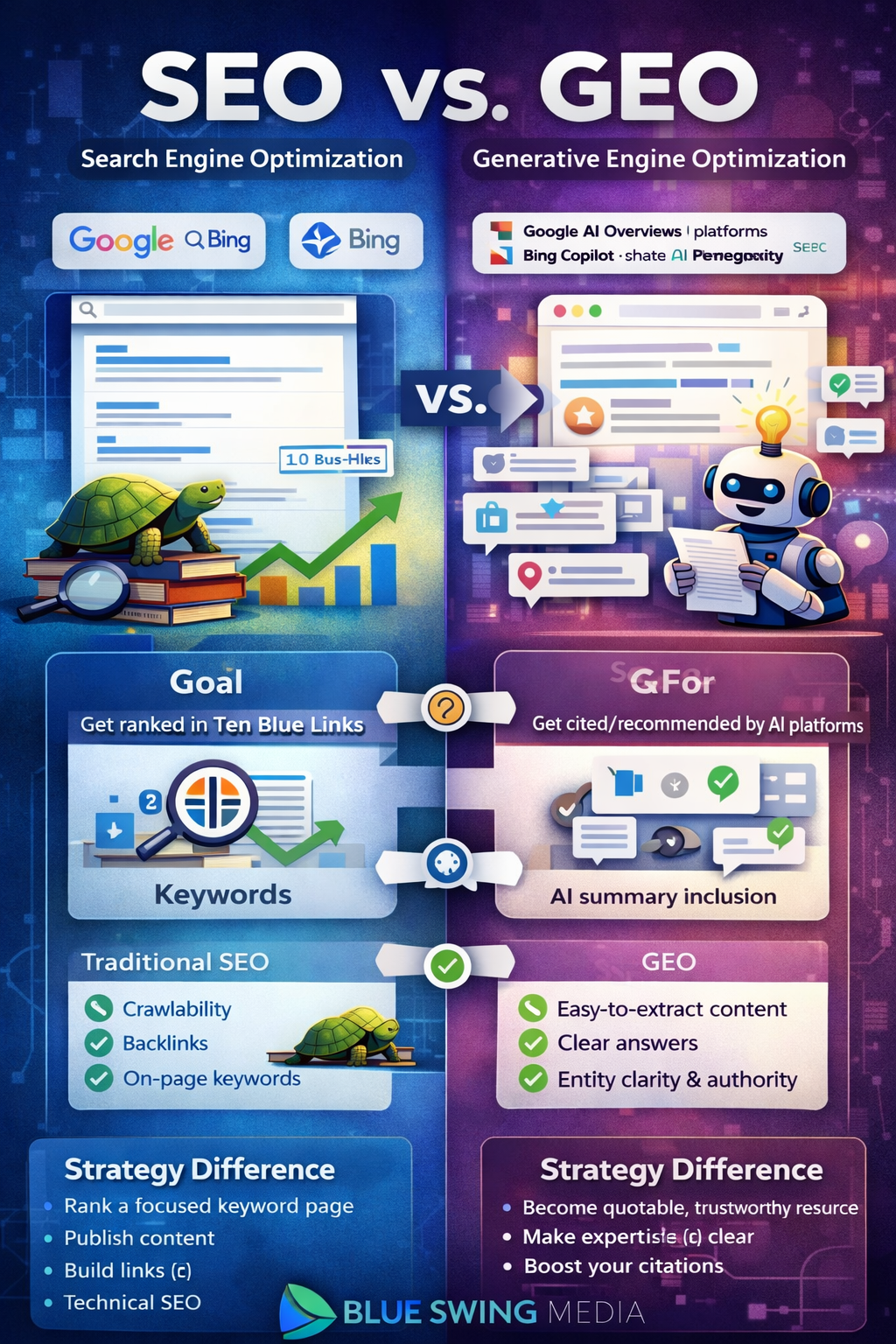
GEO is essentially the practice of optimizing your business, website, and content so that AI-driven search experiences can find, understand, trust, and reference you.
Traditional SEO has focused on helping your website rank in search engine results. GEO is more about helping your brand show up in AI-generated answers, summaries, recommendations, and citations.
In simple terms:
SEO helps you rank.
GEO helps you get referenced.
That’s a meaningful distinction.
Today, people are no longer just typing a keyword into Google and clicking through ten blue links. More and more, they are asking full questions and receiving summarized answers from AI tools. That means your content is not only competing for rankings anymore. It is also competing to become part of the answer itself.
Has SEO Been Replaced?
No.
Let me say that clearly: GEO does not replace SEO.
It builds on it.
If your website is poorly structured, your content is thin, your service pages are weak, and your business has little authority online, then GEO is not going to magically fix that. The same foundational principles still matter:
- a technically sound website
- strong service and location pages
- clear messaging
- helpful content
- consistent brand signals
- trust and authority
In other words, the tortoise still matters.
Steady, strategic digital marketing still wins over hype, shortcuts, and shiny-object syndrome. That hasn’t changed.
What has changed is that now your content needs to be useful not just for human readers and search crawlers, but also for AI systems trying to summarize the web.
Why GEO Matters
If AI-powered search experiences continue to grow, businesses that are easiest to understand and trust will have an advantage.
That means the question is no longer just:
“How do I rank for this keyword?”
It’s also:
“How do I become the kind of source that AI tools want to cite, summarize, and recommend?”
That changes the strategy.
Businesses that win in this next phase will likely have content that is:
- clear
- direct
- well-structured
- specific
- trustworthy
- supported by real-world authority
The businesses that struggle will often be the ones still publishing vague, bloated, keyword-stuffed content that says a lot without really answering anything.
What GEO Looks Like in Practice
For most local businesses, service businesses, and brands, GEO is not some mysterious technical trick. It’s really a more disciplined and strategic version of what good marketing should have been doing all along.
Here are a few examples of what that looks like.
1. Answer real questions clearly
AI systems tend to favor content that is easy to extract meaning from.
That means pages that clearly answer questions like:
- What is this service?
- Who is it for?
- How much does it cost?
- How long does it take?
- What should I expect?
- How does this compare to another option?
- Why choose this company?
If your content rambles for six paragraphs before getting to the point, that works against you.
2. Make your expertise obvious
GEO favors clarity around who you are and why you should be trusted.
That means your website should clearly communicate:
- who you are
- what you do
- where you operate
- who you serve
- what qualifies you
- what results you’ve produced
Case studies, testimonials, reviews, author bios, project photos, credentials, and examples all matter here.
3. Build authority beyond your website
This is a big one.
In the past, some people treated SEO like a website-only game. But GEO makes it even more important that your business is consistently represented across the web.
That includes things like:
- reviews
- directory listings
- local citations
- press mentions
- social proof
- guest content
- industry references
- branded searches
Your website tells your story. The rest of the web helps validate it.
4. Structure content for extraction
Good GEO content is usually easier to scan.
That means using:
- strong headings
- short paragraphs
- concise definitions
- lists where appropriate
- FAQs
- comparisons
- summaries
- clean page structure
This doesn’t mean writing robotic content. It means writing content that is genuinely helpful and easy to interpret.
What Has Changed Since 2017
When I wrote Digital Marketing with Tortoise & Hare, the emphasis was on consistency, patience, and long-term strategy. I still believe in that deeply.
But in 2017, most of the conversation was still centered around traditional websites, traditional rankings, and more linear search behavior.
Today, users are interacting with search differently. They are asking longer questions. They are using AI tools to shortcut research. They are often making decisions before they ever reach a website.
That means marketers and business owners have to think one step further upstream.
It’s no longer enough to simply publish content and hope it ranks.
Now we need to ask:
- Is this content actually useful?
- Is it easy to understand?
- Does it answer a real question?
- Does it show real experience?
- Is my business clearly positioned as a trustworthy source?
Those are GEO questions, but they are also good marketing questions.
What Should Businesses Do Right Now?
You do not need to panic. You do not need to chase every new acronym. And you definitely do not need to throw out your SEO strategy.
But you do need to adapt.
Here’s where I would start:
Audit your most important pages
Look at your homepage, service pages, and top blog posts. Are they clear? Do they answer real questions? Do they sound like they were written to help someone, or just to rank?
Strengthen your authority signals
Add testimonials, case studies, team information, service-area clarity, photos, credentials, and proof of real work.
Build better FAQ and educational content
Think beyond keywords and start thinking in terms of buyer questions and decision points.
Tighten up your structure
Use headings, summaries, bullets, and clean formatting that makes information easy to digest.
Be consistent everywhere
Make sure your business information, positioning, and messaging are consistent across your site and third-party platforms.
Final Thoughts
GEO is worth paying attention to, but it should not distract us from the fundamentals.
At its core, it is simply pushing us toward something we should have already been doing: creating content and digital assets that are genuinely useful, trustworthy, and easy to understand.
That’s not a trend. That’s good marketing.
So yes, a lot has changed since 2017.
But some of the most important truths have not changed at all.
Steady strategy still beats gimmicks. Clarity still beats confusion. Trust still wins.
And whether you call it SEO, GEO, or simply good digital marketing, the goal remains the same:
Help the right people find you, understand you, and trust you enough to take the next step.
—
Joel Conner
Blue Swing Media
Share